Forex Trading for Beginners Without the Hype
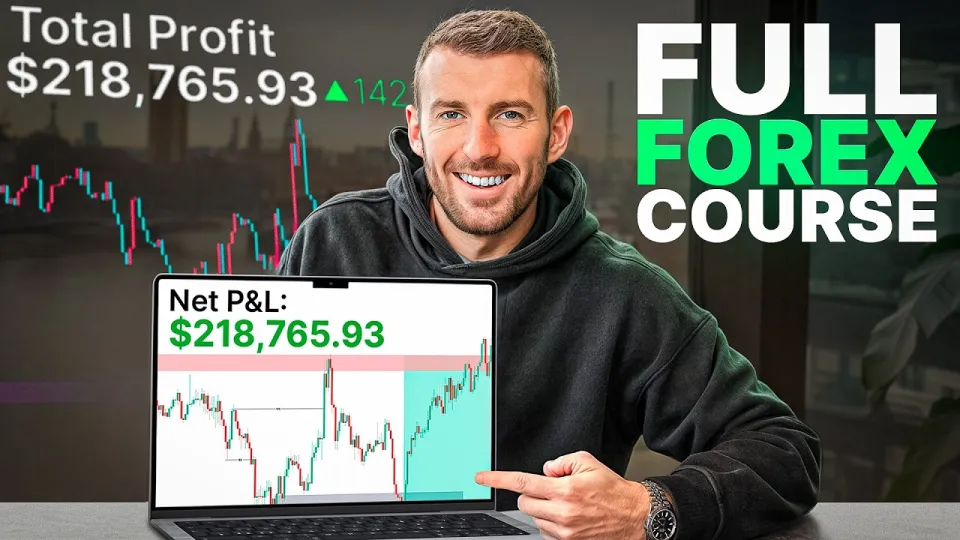
Video: Beginners Guide To Forex Trading In 2026 (+3 hours)
You can order the same kind of articles for your own video to boost it on YouTube and Google. Just message the Telegram bot @sat_sit_bot. It writes articles around your video, embeds the video and publishes them on popular niche websites (no ads). Your first 50 articles are free.
· based on the channel Matt Donlevey - Photon Trading
Key takeaways
- Forex is an over-the-counter market of currency pairs where the price is driven by order flow, not by chart shapes drawn on top of it.
- Every trade costs money before it moves: the spread between bid and ask, plus commissions and swap on positions held overnight.
- Auction market theory explains price movement as a search for areas where buyers and sellers are willing to transact size.
- Structure, premium and discount, supply and demand, and liquidity are read across multiple timeframes, then executed with a fixed entry and exit rule.
- Risk per trade, a written trade plan, backtesting and a journal matter more than any single setup.
Forex is the over-the-counter market where currencies are quoted and traded in pairs, and price moves because of real order flow — resting bids and asks being filled — not because of geometric shapes drawn on a chart. A beginner should learn that mechanism first, then build a rule-based strategy with defined entries, exits and risk. Matt Donlevey - Photon Trading lays out exactly this path in his three-hour beginners guide, and a free version of the course plus cheatsheets is available through the Photon Trading free training page.
What forex trading actually is
Forex trading is the exchange of one currency for another at an agreed price, and everything else — charts, indicators, indicators-of-indicators — is a tool for deciding when to do that exchange. The market is decentralised: there is no single exchange, only a network of banks, brokers and liquidity providers quoting prices around the clock from Monday in Asia to Friday in New York.
Retail traders almost always access it through a broker that offers leverage. That leverage is the reason beginners blow up: a position ten or fifty times larger than the account balance turns a normal intraday move into a wipeout. The instrument itself is simple — you buy EUR/USD when you expect the euro to strengthen against the dollar, sell it when you expect the opposite — but the position sizing is where the money is actually made or lost.
Currencies are quoted in pairs, and the quote has two sides at all times:
- Bid — the price at which the market will buy from you.
- Ask — the price at which the market will sell to you.
- Spread — the difference between them, which is the first cost you pay on every trade.
A pair like EUR/USD might show a spread of a fraction of a pip on a good broker, while exotic pairs and thin sessions widen it considerably. That number is not decoration: it is the amount the position must recover before it is even at breakeven.
How much money you can realistically make
There is no fixed salary in forex, and anyone quoting a guaranteed monthly percentage is selling something other than trading. Returns depend on the edge of the strategy, the number of trades taken, the risk per trade and the cost structure — and the same edge produces wildly different results depending on position size.
A useful way to think about it is in risk units rather than currency. If a trader risks 1% of the account per trade and the strategy wins slightly more than it loses over a hundred trades, the account grows steadily; if the same trader risks 10% per trade, a normal losing streak of five or six trades removes half the capital. Prop firms and funded-account programmes exist precisely because many traders can produce a decent edge but cannot fund it themselves — the model is to trade someone else's capital under a drawdown limit and split the profit.
Why price moves: order books, auction theory and order flow
The honest answer to why price moves is that somebody was willing to transact at a worse price than before — a buyer lifting offers or a seller hitting bids until the resting liquidity is exhausted. Technical analysis gets a bad reputation because most of it studies the shape of the footprint instead of the footprints themselves.
Three concepts do the real work:
- Market microstructure. The order book holds resting limit orders on the bid and ask. Market orders consume that liquidity, and the spread is the price of immediacy.
- Auction market theory. Price rotates between balance (a range where buyers and sellers agree) and imbalance (a directional move where one side is absent). Trends are simply imbalanced auctions searching for the next area of agreement.
- Order flow. Aggressive buying and selling, absorption of that aggression by limit orders, and the resulting shifts in the book explain why a level holds or breaks.
Once a trader accepts that price is a liquidity mechanism, chart patterns stop being magic and start being descriptions of where orders probably sit.
Building a strategy on market structure
A strategy is a set of rules that tells you where to look, when to enter, where to exit and how much to risk — written down, testable, and repeatable without discretion. The framework popularised in the guide rests on a handful of components that stack on top of each other.
- Market structure. Higher highs and higher lows, lower highs and lower lows, and the breaks that confirm a shift. Three structural states matter: trending, ranging and transitioning.
- Premium and discount. Within any leg, the upper half is expensive and the lower half is cheap; buying in discount and selling in premium is a location rule, not a prediction.
- Multi-timeframe analysis. The higher timeframe sets the bias, the lower timeframe provides the entry. A setup that looks strong on a five-minute chart against the daily trend is usually noise.
- Supply and demand. Zones where price left quickly because orders were unfilled, and where it may react when revisited.
- Liquidity. Clusters of stops above highs and below lows that price often seeks before reversing — the reason a clean breakout so often fails.
Put together, the sequence is mechanical: establish bias on the higher timeframe, wait for price to reach a discount or premium zone, confirm a structural shift on the lower timeframe, enter with a stop beyond the level that invalidates the idea, and target the next pool of liquidity.
Costs, brokers and execution
Trading costs are the only variable a beginner fully controls, and they compound quietly. The main ones are the spread, commission per lot, and swap — the interest charged or paid for holding a position overnight, which can turn a slow swing trade into a losing one.
Choosing a broker comes down to regulation, execution quality, spread and commission, platform reliability and withdrawal terms. A regulated broker with slightly higher spreads is usually a better partner than an unregulated one advertising zero costs. Execution discipline matters too: entering at market during a news spike can fill several pips away from the intended price, which is why limit orders at pre-defined levels are preferred.
Risk, journaling and the psychology trap
Money management is the part beginners skip and professionals obsess over. A common starting framework is risking a small fixed percentage per trade, capping daily and weekly losses, and sizing positions from the stop distance rather than from a desired profit. If the stop is far away, the position gets smaller — not the other way round.
A trade journal records the setup, the reason for entry, the result and the emotional state at the time. After fifty entries, patterns appear: the losses cluster around one specific condition, usually a trade taken outside the plan. Backtesting the same rules over historical data before risking anything turns a hunch into evidence.
Psychology is downstream of competence. Traders who have not yet built and tested an edge cannot fix their discipline problem, because there is no defined behaviour to be disciplined about. Master the rules first; the fear and greed management becomes a real, solvable problem only after the strategy is mechanical.
Common beginner questions answered
Three doubts come up again and again in the comments under long-form courses like this one. The first is speed and accessibility — a dense three-hour walkthrough is hard to follow for non-native speakers, so slowing playback, using captions and pausing at each timestamped topic is a legitimate study method rather than a compromise.
The second is whether free material can be worth anything when similar guides are sold for four figures. The structure of the market does not change with the price of the course; what paid mentorship adds is feedback and accountability, not secret knowledge.
Useful links
- Free Photon Trading course and cheatsheets
- Photon Trading mentorship programme
- Free Telegram channel with analysis and trade recaps
- Photon Trading on Instagram
Final thoughts
Forex rewards traders who understand the mechanism behind price and then apply a small number of rules with consistent risk, and it punishes those who collect patterns without a plan. The value of a long, systematically structured walkthrough is that it connects microstructure, structure, risk and psychology into one coherent process instead of disconnected tips. Matt Donlevey - Photon Trading built his beginners guide around exactly that logic, and the free training and cheatsheets are the natural next step after watching it. Start with one pair, one timeframe and one written plan, then let the journal tell you whether the edge is real.
Source: Beginners Guide To Forex Trading In 2026 (+3 hours) · Markdown version
Questions & answers
How much money do I need to start trading forex?
There is no universal minimum, but the account size must be large enough that a normal losing streak at your risk per trade does not threaten the balance. Many beginners start on a demo account and only go live once a written plan has survived backtesting and a few dozen journaled trades.
Is technical analysis useless, as some traders claim?
Technical analysis is only useless when it studies shapes without reference to why price moves. Structure, supply and demand, and liquidity levels are useful because they describe where orders are likely resting; a triangle drawn on a chart with no order-flow logic is decoration.
Can I learn forex from a free three-hour video?
A structured free course can cover the full map — market mechanics, structure, risk and psychology — but watching is not learning. The material only becomes useful when each concept is applied in a backtest and recorded in a journal, which is where paid mentorship usually adds feedback.
Why do most beginners lose money on their first account?
The usual causes are oversized positions from leverage, trading without a written plan, ignoring spread and swap costs, and taking setups that contradict the higher-timeframe bias. Fixing risk per trade and journaling every entry removes most of them.